
Research opportunities

Cerebral Palsy – Hōkai Nikurangi is an exciting area of research, science, and clinical practice. Discoveries are being made all the time particularly when it comes to specific areas of living with CP, such as the difference between Level I and V.
The Cerebral Palsy Society regularly gets approached with research opportunities. This page is a place to learn about different studies that are on offer.
By getting involved in research, you’re helping create a more informed and clearer picture for people with CP across Aotearoa New Zealand, guiding advocacy and efforts towards change.
- If you are interested in learning more about the studies listed below, please contact the researcher directly.
- If you would like information about CP research in general, please contact Cerebral Palsy Society Researcher and Writer Amy Hogan amy@cpsociety.org.nz.
- Anyone interested in having their research featured on this page should contact Cerebral Palsy Society Researcher and Writer Amy Hogan amy@cpsociety.org.nz. Please supply an intro of no more than 200 words, a video or written document explaining your research, a suitable photo (or logos), and any other relevant documents.
Looking for Lived Expertise to Guide Research
February 24, 2026
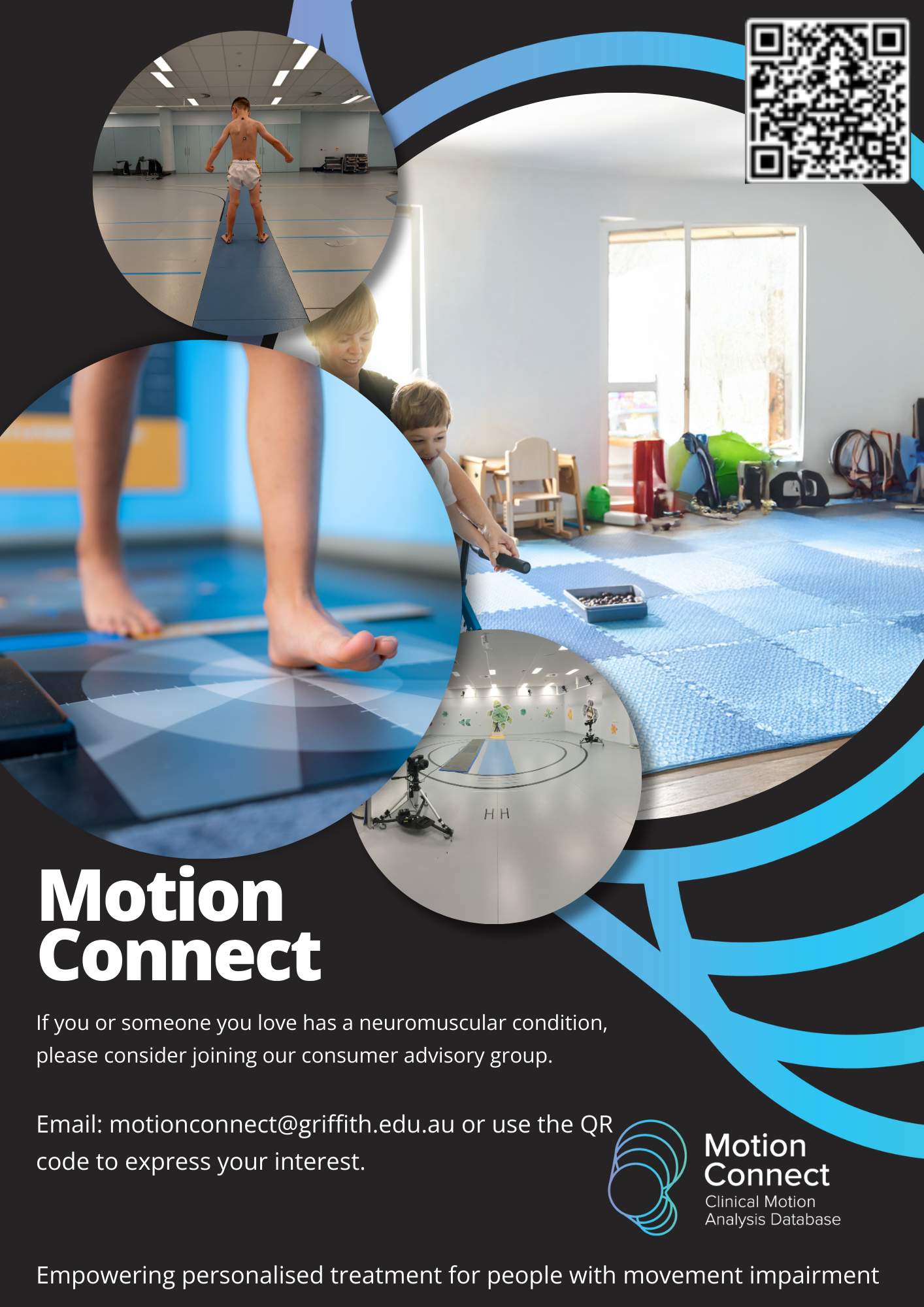
The Motion Connect study aims to collect and share information about how people with neuromuscular conditions walk (clinical gait data) to inform treatment options for conditions such as cerebral palsy, spina bifida, and muscular dystrophy. Motion Connect is a collaboration between Australia and New Zealand researchers and clinical therapists that will develop a database of gait types and treatment outcomes that will help direct care for people in a more targeted, evidence-based way.
We are looking for people with lived experience of these conditions, or their carers or representatives, to join our research team and provide input and feedback throughout the research process. Your role will be to advise our research team on matters important to the community, review all community-facing information to make sure it is clear and accessible, and to ensure that the wellbeing of people with neuromuscular conditions remains at the heart of every decision.
We would like to hear as many perspectives as possible, so encourage applications from people of any age, gender, ethnicity, ability, family structure, location, or education level. All information shared will be accessible and we will make accommodations as needed to ensure all voices are heard (eg. AAC users).
Your time commitment
We expect to meet up to 10 times for 1-hour meetings online in 2026 and 2027. We will work with our consumer advisors to find the best date and time for these meetings. You will be paid for your time at approximately AU$50/hr (in line with the Health Consumers Qld Consumer Remuneration Position Statement 2025-26).
For more information
Please fill out this expression of interest form – we will be in touch with you with regards to following up your application in the coming weeks. This form should take around 5 minutes to complete.
If you would like to complete this form with us over the phone or would like to connect with us for any other reason, please contact Dr Fiona Russo on +61 404 246 223 or email f.russo@uq.edu.au.
Expression of Interest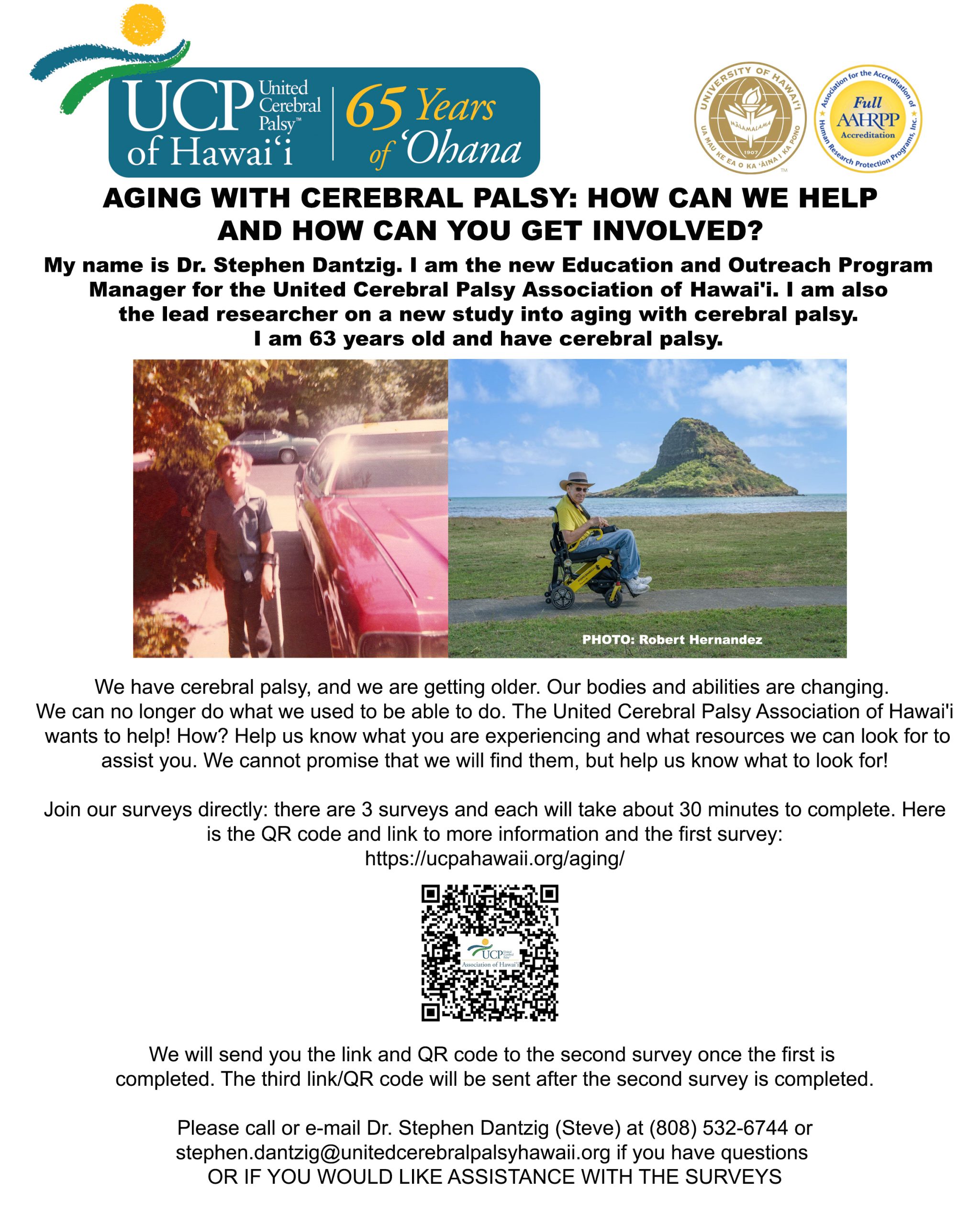
Impact of Aging With Cerebral Palsy Study – (Inter)National Survey
December 10, 2025
The United Cerebral Palsy Association of Hawai’i has embraced the humanitarian need to continue to research the effects of aging with cerebral palsy along with potential interventions to help.
Their study consists of seven questionnaires over three surveys investigating changes in physical skills, pain levels, adaptive skills, communication skills, medical/mental health needs, current concerns, and the need for resources.
The study is open to adults with cerebral palsy who are 20-years of age older and/or caregivers, if applicable.
The Impact of Aging with Cerebral Palsy—A Brief Summary (published at https://ucp.org/the-impact-of-aging-with-cerebral-palsy/)
Cerebral Palsy Is Not Just a Childhood Disorder—it has been reported that there are more adults with cerebral palsy than children!
While the damage that causes cerebral palsy is not progressive, adults with cerebral palsy often face a significant increase in spasticity, ataxia, athetosis, pain, social isolation, depression, anxiety, and more.
The information will be gathered, analysed and sent to all community agencies that work with people with disabilities, our legislature, and because this is now an international survey, all state Department of Health agencies as well as agencies from the countries of international respondents.
The link to the first survey is below. Surveys two and three will be sent as they receive each survey.
– More information on the aging with cerebral palsy study: https://ucpahawaii.org/aging/
– United Cerebral Palsy blog on the study: https://ucp.org/the-impact-of-aging-with-cerebral-palsy/
Assistive Technology Survey
December 10, 2025
Intopia invites you to take part in the Assistive Technology Survey 2025, a survey exploring how people across Australia and New Zealand use and experience assistive technology.
Intopia aims to understand:
- What assistive technologies and adaptive strategies people use
- Which devices and browsers are most popular
- What the online experience is like for assistive technology users.
Your input will help:
- Identify barriers to access and inclusion
- Inform policy and funding decisions
- Shape the design of future assistive technologies
Whether you use assistive technology yourself, or support someone who does, your voice matters. The survey is accessible, confidential and it is estimated to take around 15 to 25 minutes to complete.
The survey is open until 6 February 2025.
Start the Assistive Technology Survey 2025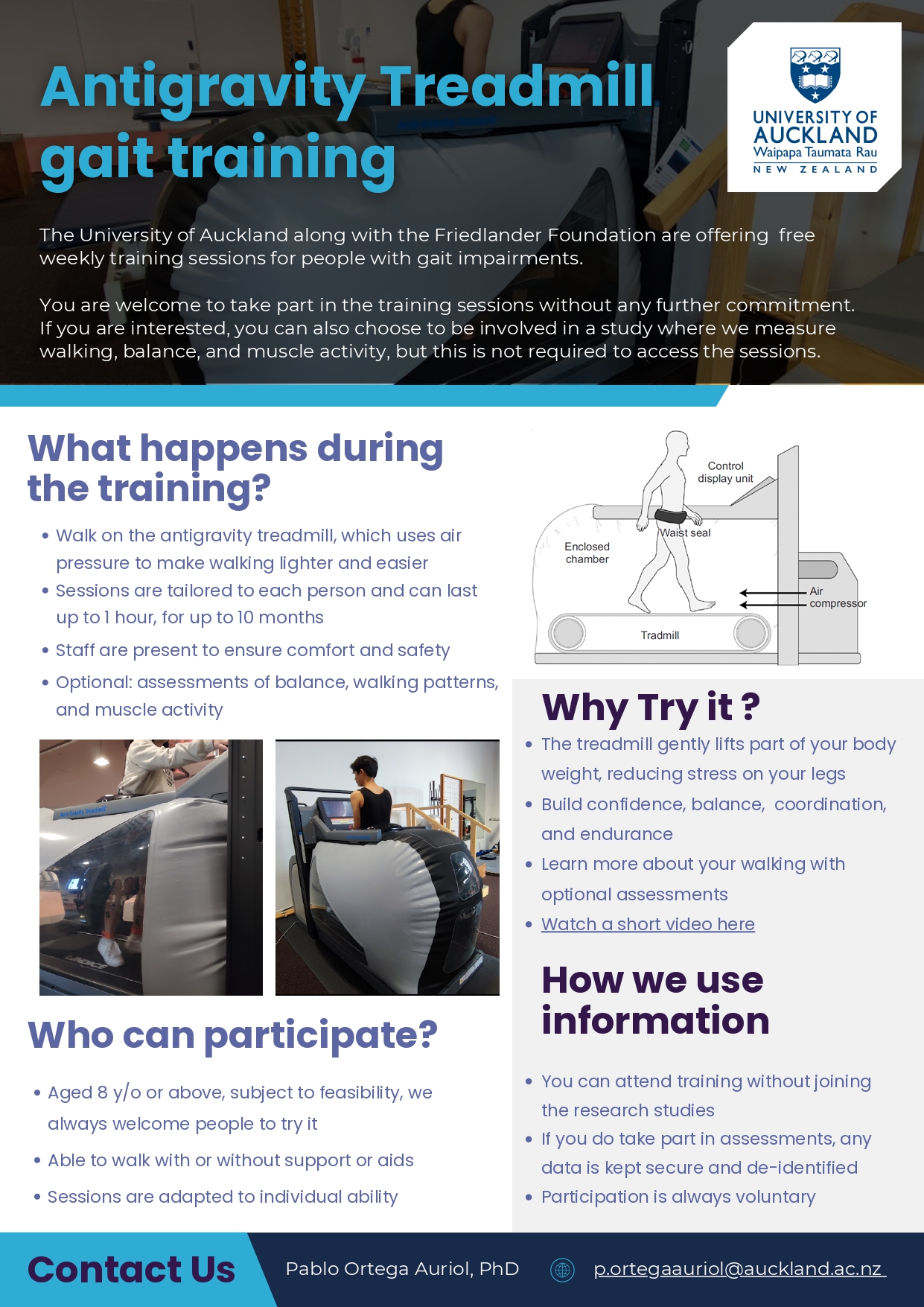
Free gait training sessions
October 13, 2025 – updated December 12, 2025
Researchers at the Auckland Bioengineering Institute have concluded the first research phase of their anti-gravity treadmill project. Given the great progress some participants achieved, they have expanded their scope to offer the training free of charge to the community. Weekly sessions run at the Newmarket campus between 9am and 5:30pm. There are spaces for more participants.
The positive-pressure (“anti-gravity”) treadmill reduces body weight loading and makes walking easier and more efficient. The researchers see this as a complementary form of physical activity alongside existing therapy or exercise routines.
Watch this video to see how the treadmill works: https://youtu.be/R5vkpDBzIyk?si=7tfP4twIZkd_E_SR
For more information contact Pablo Ortega-Auriol, Research Fellow, Auckland Bioengineering Institute – p.ortegaauriol@auckland.ac.nz
* Clinicians who would like to visit and learn more about the sessions and services for their patients are more than welcome to get in touch.
More informationJoin Our Online Community
It’s an important time to be connected. Connecting with your community is an incredibly powerful way to beat isolation at this time.
Join our online community today where you can speak with CPS staff, and other families around New Zealand who either have, or know someone living with Cerebral Palsy.
Visit our FacebookRequest A Call From Our Team
We’re here to help. If you’re feeling isolated or need support, our team is available to talk. Sometimes, having someone to chat with can make a huge difference during this time of isolation.
Why not request a call or email from the team today?
Request a call